Prehistoric Period to the Selangor Sultanate

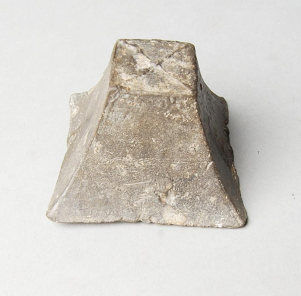
Located in the middle of the Straits of Malacca, Klang is one of the oldest settlements in the Malay Peninsula. Based on the discovery of Stone Age artefacts such as stone adzes, stone knives, pottery and earthenware jars, wooden boats, and beads, human settlements have existed in the Klang River–Langat River valley for about 4,500 years.
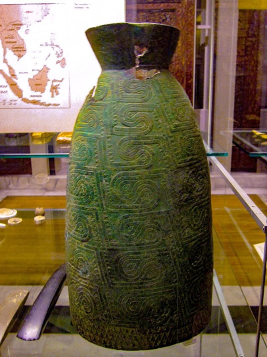
These settlements continued to develop with the discovery of metal artefacts such as bronze drums and bells, as well as socketed iron tools dating back approximately 2,500 years.
The earliest settlements along the coastal area of the Klang River were located at the confluence of the Rasau River and the Klang River, around Bukit Jati, Bukit Kuda, and Bukit Badak, before a new settlement was established at Pengkalan Batu about 800–900 years ago.
Klang was once a territory under the rule of Srivijaya, Majapahit, the Malacca Malay Sultanate, and the Old Johor Sultanate, and was also one of the states that formed the original Negeri Sembilan, before coming under the rule of the Selangor Sultanate beginning in November 1766 until today.
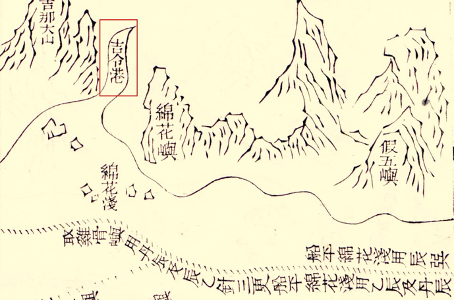
Based on ancient Chinese records, the earliest reference to Klang dates back to the 8th century AD, when Tang Dynasty cartographer Chia Tan recorded the name Ko-Lo on his maritime map. The Chinese text Tao-I Chih-lioh from the 14th century AD referred to Klang as Ku-Lei. Klang was also recorded on the maritime map of Admiral Zheng He in 1415 under the name jí lìng gǎng (吉令港).
In 1365 AD, Klang was mentioned in the Negarakertagama, a Javanese epic poem by Prapanca, as one of the territories of Majapahit. The Sejarah Melayu or Sulalatus Salatin also records that Tun Perak served as the Penghulu of Klang during the early period of the Malacca Malay Sultanate.
The Origin of the Name Klang
There are various opinions regarding the origin of the name Klang itself. Western scholars have suggested that the word Klang means warehouse or canal, based on the Mon-Khmer language found in Indo-China. However, the absence of strong evidence of Mon-Khmer influence or presence in Klang makes this view difficult to accept, especially since the Mon-Khmer communities themselves did not use bronze drums.
Local Klang sources that are rarely discussed or studied—namely oral traditions known as tambo—also recount stories about the origin of the name Klang. Among the Orang Asli community, Klang is believed to have derived its name from the word gelang (bracelet), where a bracelet that drifted from the upper reaches of the river was later found at the mouth of the Klang River. Among the Minangkabau people, who began migrating to Klang as early as the 13th century, Klang was referred to as Pai Kolang, meaning a place that is always remembered. Even today, several place names in Klang are identical to those found in West Sumatra (the Minangkabau homeland).
Another tambo narrative tells that Klang derived its name from the sound of bells, gongs, or bronze drums that were frequently heard from the hills in the early morning and late afternoon by ships sailing past the mouth of the Klang River in the past. This account corresponds with the discovery of bronze bells and drums in Klang and is therefore considered a more convincing explanation for the origin of the name Klang.


Traditional Governance
Traditional governance represents the earliest governing institution in Klang. Beginning with the kedatuan institutions under the rule of Srivijaya and Majapahit, it later developed into the institution of the Penghulu during the period of the Malacca Malay Sultanate.
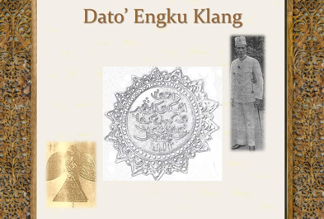
During the era of the Old Johor Sultanate, Dato’ Engku Klang was appointed as the Pembesar Klang, serving as the representative of the Sultan of Johor Lama who governed the Klang Darat region. At the same time, the Pagar Ruyung Kingdom of Alam Minangkabau also sent its representative to Klang, known as Dato’ Bendahara Kuning Lima Kaum Orang Kaya Klang, who governed the Klang Pantai region.
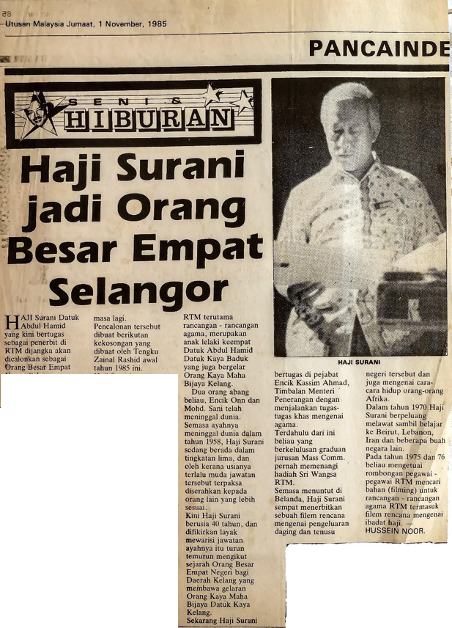
Together with Dato’ Seri Agar Diraja of Kuala Selangor, these leaders were known as the Andika Sedia Diraja, as they possessed full authority similar to that of a ruler over their respective territories. In the 18th century, the title Andika Sedia Diraja later evolved into the Dato’ Besar Empat Suku Klang, consisting of Dato’ Kaya Klang, Dato’ Jeram, Dato’ Penggawa, and Dato’ Aru, and led by Dato’ Engku Klang.
Following the establishment of the Selangor Sultanate, all four Dato’ Besar Empat Suku, together with Dato’ Engku Klang, retained their positions as the original rulers and were recognised as the Waris Negeri (hereditary leaders of the state).
Klang War to British Administration
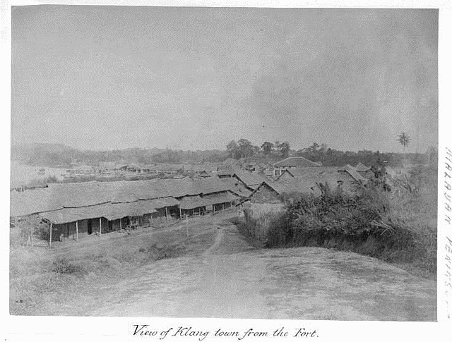
Klang’s natural heritage, namely tin, also played a significant role in shaping its history, as it was a highly sought-after commodity by several empires and various peoples from across the world. The wealth generated from tin ore extracted from the inland areas of the Klang River was one of the main causes of the Klang War, which took place between 1866 and 1874.
This civil war involved the Bugis nobility of Selangor together with Selangor chiefs, against the Bugis of Riau allied with people from Kedah and Pahang, as well as their respective supporters, including the Minangkabau, Rawa, Batu Bahara, Mandailing, and Chinese communities.
As a result of this conflict, the British intervened in the administration of Selangor by appointing a Resident in Klang in 1875.
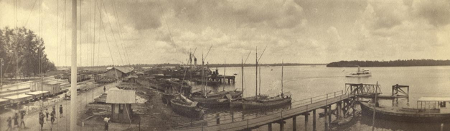
Klang town has served as an administrative centre since the time of Srivijaya. When the Selangor Sultanate was established, the seat of government was moved to Kuala Selangor in 1766, then to Jugra in 1859, and back to Klang in 1875 until 1880, when the state capital of Selangor was relocated to Kuala Lumpur.
The rapid economic development in Klang and Kuala Lumpur during the late 19th century witnessed the growth of tin mining, agriculture, education, healthcare, and transportation and communication systems. The construction of a new port, Port Swettenham in Kuala Klang in 1901, further boosted trade activities not only in Klang but throughout Selangor. Additionally, an airfield was established in Kuala Klang and Kelanang in 1934 for use by the British Royal Air Force at that time.
Royal Town Status
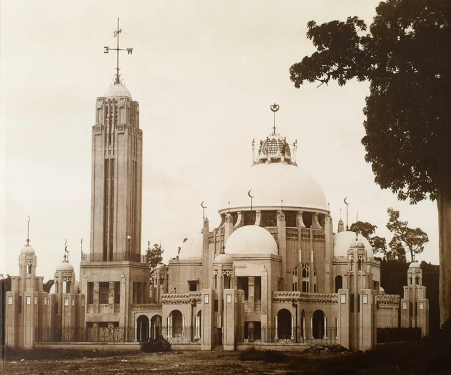
The Royal Town status of Klang further strengthened its existing heritage elements. The Sultan of Selangor began residing in Klang in 1903 when Istana Mahkota Puri was completed on 30 December 1902. Construction of the palace began on 5 March 1900, and it was presented as a gift from the British in conjunction with the coronation of Sultan Ala’eddin Suleiman Shah. The name Istana Mahkota Puri was officially announced on 6 November 1903.
The inauguration of Masjid Suleiman Jamiur Rahmah (Sultan Suleiman Royal Mosque) on Friday, 23 June 1933 symbolically marked Klang as a Royal Town. Since then, Klang has been closely associated with the title of Royal Town.
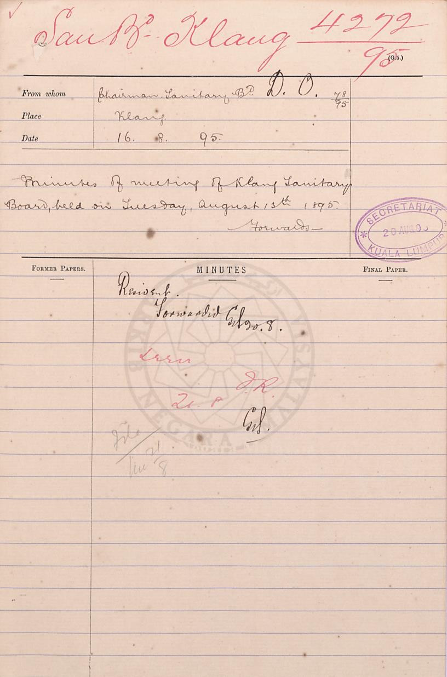
Establishment of the Klang Sanitary Board
In 1889, the Resident of Selangor, W.E. Maxwell, proposed the establishment of local authority agencies to implement and manage municipal functions at the local level. Accordingly, to streamline the administration of Klang town, the Selangor Government established the Klang Sanitary Board on 1 August 1890, alongside the Kuala Lumpur Sanitary Board (14 May 1890) and the Kuala Kubu Sanitary Board (29 December 1890). Among the Malay community in Klang at that time, this board was referred to as “Santaribut”.
The Klang Sanitary Board was placed under the administration of the Selangor Resident. Its members, whether official or unofficial, were appointed by the Resident, while the District Officer of Klang was automatically appointed as the Chairman of the Board.
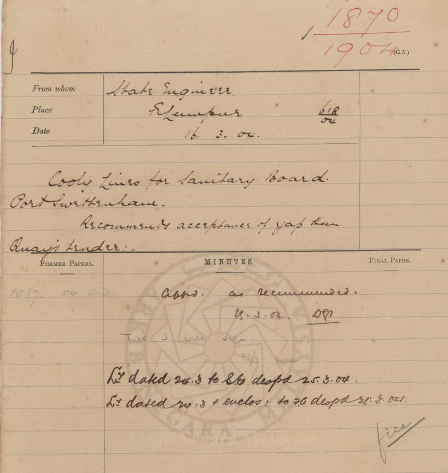
The year 1903 saw the opening of Port Swettenham, and to administer the Kuala Klang area, the Port Swettenham Sanitary Board was established in 1904.
The administrative areas of the Klang Sanitary Board were defined in 1903, alongside the jurisdiction of Port Swettenham in 1904, under the Sanitary Boards Enactment 1902.
In 1904, a new Sanitary Board Enactment was passed to expand its powers and update the appointment of members. In 1907, the Sanitary Board Enactment, FMS Cap. 137 was approved by the Resident-General, strengthening the involvement of the central government of the Federated Malay States in local government affairs.
To formulate a plan for the physical development of the town, the government of the Federated Malay States passed the Town Planning Enactment in 1923, followed by the Town Planning Rules in 1924, which outlined regulations for urban planning. Through this enactment, a Town Planning Committee was established, further improving the development of Klang town.
The Klang Sanitary Board underwent several upgrades in line with its successful administration of the town. The year 1926 marked an important milestone in the history of local government in the Klang district, as the Klang Health Board and Port Swettenham Board were merged under the Klang Health Board until 1945. This merger was carried out not only due to their proximity and the need to jointly develop both areas, but also to strengthen the financial position of the Board and streamline administration.
Post-World War II to the Construction of the MPK Building
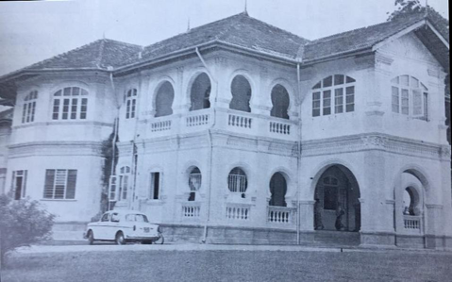
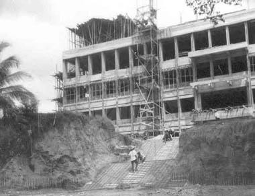
After World War II, the British Military Administration (BMA) issued a proclamation stipulating that all local authorities were to be established as Municipal Boards. Consequently, in December 1945, the Klang Municipal Board was formed, although in practice it continued to carry out the functions of the Klang Sanitary Board.
The Klang Rest House, formerly the mansion of Dato’ Bentara Kiri Amar Diraja, was converted into the office of the Klang Municipal Board beginning in 1949.
During the administration of the Malayan Union in 1946, local government matters fell under the jurisdiction of the central government and were only returned to the state governments upon the establishment of the Federation of Malaya on 1 February 1948.
Under the provisions of the Municipal Board Enactment, the official and unofficial members of the Municipal Board were appointed by the Sultan of Selangor during meetings, and he held absolute authority in determining the Board’s jurisdiction. The Klang Municipal Board was chaired by the District Officer of Klang and comprised official and unofficial members appointed by the Sultan. However, the Klang Municipal Board had no financial autonomy, and this administrative system remained in place for nine years.
Establishment of the Kelang Municipal Council (1954)
The enforcement of the Local Government Ordinance 1952 brought significant changes to local government administration in the country. This ordinance allowed citizens to participate directly in local governance through elections, in line with efforts to implement a Parliamentary Democracy in the country ahead of independence.
The Local Government Election Ordinance 1950 enabled the Kelang Municipal Board to be upgraded to the Kelang Town Council when all or part of its members were elected through a public election. In accordance with these provisions, the Kelang Town Council was established on 3 December 1954, administering two areas: Kelang and Port Swettenham. This new status provided greater opportunities for Kelang residents to participate in shaping local government policies.
Under the Constitution of the Kelang Town Council 1954, the council was an independent body with financial autonomy. Its membership consisted of four government officers serving as Ex-Officio members: the District Officer of Kelang as Chairman, the Chief Assistant District Officer as Deputy Chairman, the District Engineer of Kelang and Kuala Langat, and the Director of Health Kelang. The Kelang Town Council was empowered to conduct elections to select council members, known as Town Councillors.
Nine council members were elected by Kelang residents, while four were appointed from prominent local figures. The nine elected members represented three electoral wards: North Kelang, South Kelang, and Port Swettenham, with three representatives per ward. The first Town Council election was held on 4 December 1954, and all seats were won by the Alliance Party, with three candidates elected unopposed on nomination day.
The Kelang Town Council administered an area of 10.6 square miles (27.45 km²) with a population of 71,000 at that time. The taxable property value was estimated at $3,000,000, with government revenue around $4,778,000 and expenditures approximately $564,400.
The Local Councils Ordinance 1952 also created another type of local authority, known as Local Councils, established in rural areas, particularly in new villages set up to resettle squatters from forest fringes as part of the government’s efforts to counter the communist insurgency. These Local Councils comprised elected members and were financially autonomous, although expenditures had to be approved by the respective District Officer. In the Kelang district, two Local Councils were established: Kapar Local Council and Meru Local Council.
Developments in the Early 1960s
In 1960, the Local Government Elections Act was implemented, aiming to ensure that elections were held simultaneously nationwide every three years, and the electoral wards system was abolished. The retirement of council members had to be postponed several times to facilitate a smooth election process. Following these developments, the Constitution of the Kelang Municipal Council was replaced by the Kelang Municipal Council Order 1961 as the new constitution. In the 1963 Kelang Municipal Council elections, 12 seats were contested, with the Alliance Party winning seven seats and the remaining five seats won by opposition parties.
Around July 1960, during the near completion of Istana Alam Shah, Sultan Hisamuddin Alam Shah approved the relocation of the Selangor Islamic Religious and Malay Customs Office to Istana Bukit Kota, located within the Kota Raja Mahadi area in Klang.
According to the plan, the three religious offices, including the Shariah Court, which were previously located separately at Jalan Tepi Sungai and Jalan Kampung Jawa, were to be consolidated under one roof at Istana Bukit Kota, while the District Kadi Office of Klang remained separate. Initially, the Selangor Government had allocated a plot of land but provided no building, prompting Sultan Hisamuddin Alam Shah to grant Istana Bukit Kota for this purpose.
However, a year later, changes occurred following the demise of Sultan Hisamuddin Alam Shah. This was the result of meetings and negotiations between M.R. Read, the District Officer of Klang, together with the Municipal Council members at the time, and Sultan Salahuddin Abdul Aziz. They requested that Istana Bukit Kota be designated as the Kelang Municipal Council Office instead of the Islamic Religious and Malay Customs Office, and proposed that the Islamic Religious Office take over the former council building at Jalan Sultan (now Jalan Hamzah) in exchange.
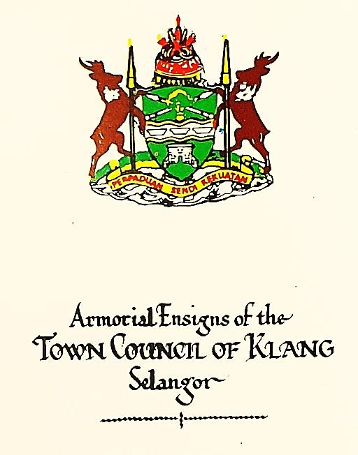
Official Coat of Arms and New Building
In preparation for acquiring a new building at Bukit Kota (Kota Raja Mahadi), the Kelang Municipal Council planned to create an official coat of arms in early 1961.
An application was submitted to a firm in London to obtain a quotation for the coat of arms design. This same firm had previously designed the coat of arms for the Kuala Lumpur Municipal Council (now the Kuala Lumpur City Hall).
In August 1961, the Kelang Municipal Council officially appointed the firm Messrs. Chester Herald of Herald, England, to design the council’s coat of arms. A payment of $1,000.00 was approved in October 1961 for the design of the coat of arms and the official seal of the Kelang Municipal Council.
Once the design was completed, the coat of arms was registered by Lancaster Herald and Registrar at the prestigious College of Arms (Heralds’ College), London.
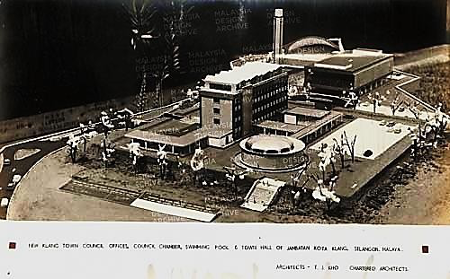
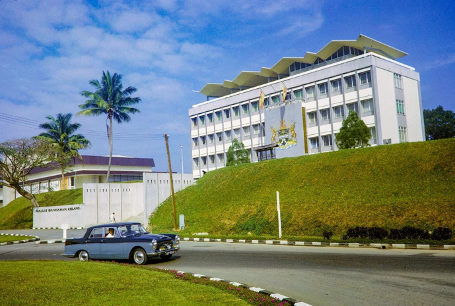
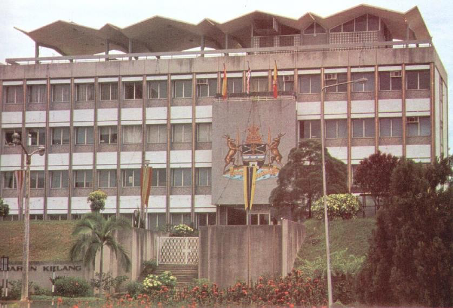
Construction of the Kelang Municipal Council headquarters began in late 1963 after Istana Bukit Kota was demolished due to structural deterioration. According to the original plan, the municipal complex, valued at $700,000.00, was to include an air-conditioned council chamber, a municipal hall, a clock tower, a swimming pool, a badminton court, and a basketball court. However, the swimming pool and sports courts were cancelled due to space constraints and rising construction costs.
The Kelang Municipal Council building was designed by Mr. Kho Tje Jam of T.J. Kho Chartered Architects, with Rankine & Hill as structural engineers, and construction carried out by Kenneison Bros. Ltd. The electrical work was handled by Pang & Liu, while Crisp, Kavanagh and Partners served as quantity surveyors.
The main office building features a 28-foot by 22-foot multicoloured mosaic glass mural as its main façade, serving as the backdrop for the newly designed Klang Municipal Council coat of arms. The building, which incorporates elements inspired by Malay culture, was named the Sultan Abdul Aziz Shah Building.
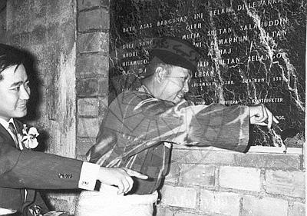
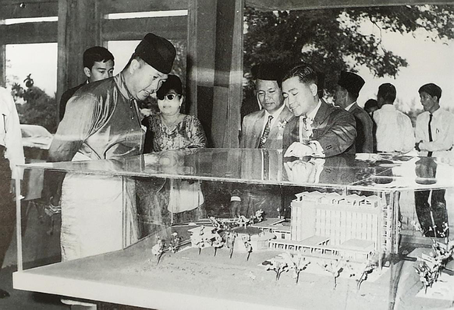
The foundation stone of the building was laid on 6 January 1964 by Sultan Salahuddin Abdul Aziz Shah. The Sultan Abdul Aziz Shah Building was completed in July 1964 at a cost of $1 million and was officially inaugurated on 1 November 1964.
Confrontation Era to the 100th Anniversary Celebration
On 3 September 1964, the Selangor Government passed a resolution to grant fully-elected status to the Kelang Municipal Council by 1966. At that time, Kelang Municipal Council, being the only municipal council in Selangor with a population approaching 100,000, was set to attain municipal status in the near future.
However, due to the landing of Indonesian troops at Pontian and Labis in the state of Johor on 2 September 1964 during the Malaysia–Indonesia Confrontation, the Federal Government declared a state of Emergency and postponed all local government elections on 28 May 1965. The existing council members were allowed to continue their duties until further notice by the government.
Following the takeover of several local authorities by their respective state governments, the Federal Government established a Royal Commission to review the functions and implementation of Local Government laws in every state in Peninsular Malaysia.
Although local government elections were postponed, in 1972, the administrative area of Kelang Municipal Council was expanded to 21 square miles (54.4 km²), covering North Klang Strait as well as the industrial and residential areas surrounding Klang town and Port Klang.
Formation of the Klang District Council (1971)
On 3 September 1964, the Selangor Government passed a resolution to grant fully-elected status to the Kelang Municipal Council by 1966. At that time, Kelang Municipal Council—being the only municipal council in Selangor with a population approaching 100,000—was set to achieve municipal status in the near future.
However, due to the landing of Indonesian troops at Pontian and Labis in Johor on 2 September 1964 during the Malaysia–Indonesia Confrontation, the Federal Government declared a state of Emergency and postponed all local government elections on 28 May 1965. The existing council members were allowed to continue their duties until further notice.
Following the takeover of several local authorities by their respective state governments, the Federal Government established a Royal Commission to review the functions and implementation of Local Government laws in every state across Peninsular Malaysia.
Although local government elections were postponed, in 1972, the administrative area of the Kelang Municipal Council was expanded to 21 square miles (54.4 km²), covering North Klang Strait as well as the industrial and residential areas surrounding Klang town and Port Klang.
100th Anniversary of Klang Administration (1990)
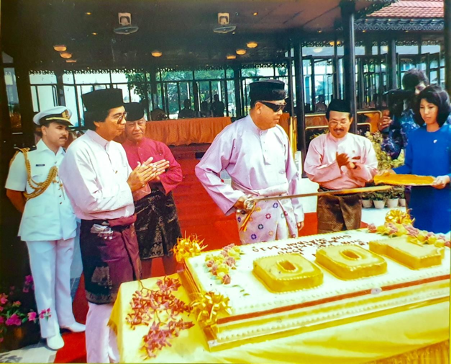
On 1 August 1990, the Klang Municipal Council celebrated its 100th anniversary under the theme “Klang Continues to Develop.” The 100th Anniversary Celebration of Klang Administration was jointly organized by the Klang Municipal Council and the Klang District Office.
In conjunction with this celebration, the Public Relations Division of the Council’s Administration Department, in collaboration with other internal departments, organized various cultural, sports, and educational events to foster goodwill among the residents of Klang as well as the staff of the Klang Municipal Council.
The celebration began with the Launch Ceremony of the 100th Anniversary of Klang Administration held at Padang Sultan Suleiman (Kota Raja Stadium) on Saturday, 3 March 1990. This date also coincided with the Sultan of Selangor’s Birthday, Sultan Salahuddin Abdul Aziz Shah Al-Haj ibni Almarhum Sultan Hisamuddin Alam Shah, marking the 30th anniversary of his reign. The launch ceremony featured a tattoo performance, fireworks display, and decorated vehicle parade.
The Sea Sports Festival was held on Sunday, 4 March 1990, followed by a Thanksgiving Ceremony on Monday, 5 March 1990. On Saturday, 2 June 1990, the Klang District Fishing Competition was held at Pantai Esplanade (Tanjung Harapan), Bandar Sultan Suleiman.
All the events organized were also aimed at promoting Klang as a historic Royal Town, renowned for its seafood, to tourists and visitors from both within and outside the country, in conjunction with the Visit Malaysia Year 1990 program.
On Sunday, 19 August 1990, the International Kart Prix Competition was held at the Pandamaran Sports Complex. The 100 Years of Klang Concert took place on Saturday, 25 August 1990, followed by the Treasure Hunt Competition the next day, Sunday, 26 August 1990.Minutes of the Port Swettenham Sanitary Board meeting in 1904
Bandar Sultan Suleiman, Port Klang, was officially inaugurated on Wednesday, 5 September 1990, followed by a Blood Donation Campaign on Thursday, 6 September 1990. The celebrations concluded with a Gala Dinner held on Saturday, 8 September 1990, marking the end of the 100th Anniversary Celebration of Klang Administration.
All the events organized were also aimed at promoting Klang as a historic Royal Town, renowned for its seafood, to tourists and visitors from both within and outside the country, in conjunction with the Visit Malaysia Year 1990 program.
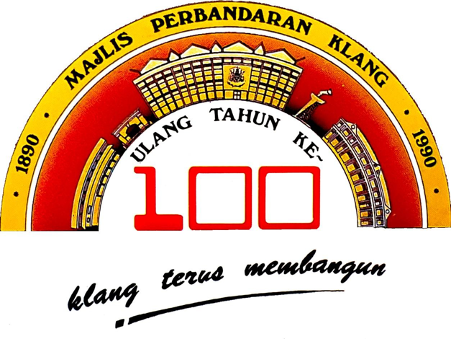
A special logo was designed to symbolize the 100th anniversary of the Klang Municipal Council. The logo highlights the concept of Klang’s transformation and development from the past up to 1990, while the illustration of buildings represents the presence of various historical monuments in Klang town. The number 100, styled in a computer font, signifies the adoption of new ideas and advanced technology practiced by the Klang Municipal Council in embracing the new era and its efforts to deliver excellent services.
Service Innovations
In 1990, the Klang Municipal Council (MPK) broadcasted on the radio for the first time in collaboration with Radio Televisyen Malaysia (RTM) as part of its efforts to provide the best services to the public. The program “MPK dan Anda” aired biweekly on Radio Tiga Shah Alam (Selangorfm) every Thursday at 8:30 a.m. The show aimed to gather feedback, issues, and complaints from Klang residents directly, with each submission being forwarded to the relevant departments for action and follow-up.
Kampung Meru, located approximately eight kilometers from Klang, celebrated its 100th anniversary on 9 August 2003. Originally an area of agricultural land and scrub, the village has developed into a residential, industrial, and urban area.
Modern Expansion to Royal City Status
Starting from 3 March 2005, the administrative area of the Klang Municipal Council expanded to cover almost the entire Klang district. This expansion increased the council’s area from 185 km² to 574 km², as we see today.
Efforts to Upgrade to City Status
In 2006, the Klang Municipal Council began efforts to elevate its status to the Klang Royal City Council (Majlis Bandaraya Diraja Klang, MBDK). Several initiatives were undertaken in collaboration with the Office of His Royal Highness the Sultan of Selangor, the Selangor State Government, the Ministry of Housing and Local Government, the International Council on Monuments and Sites (ICOMOS) Malaysia, public and private higher education institutions, as well as non-governmental organizations including the Malaysian Historical Society.
Klang Municipal Council became the first local authority to appoint a Curator responsible for matters related to history, heritage, and royal institutions on 1 January 2021.
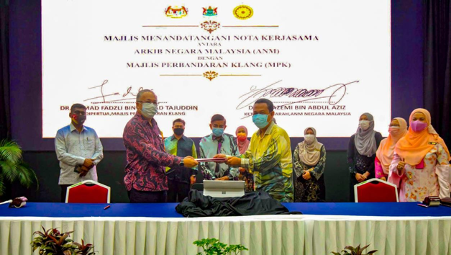
On 1 April 2021, Klang Municipal Council signed a Memorandum of Understanding with the National Archives of Malaysia, marking the first collaboration between the National Archives and a local authority in Malaysia.

Achievement of City Status (2023–2024)
In 2023, at the age of 133 years, the Klang Municipal Council (MPK) had fulfilled all the criteria to attain city status, with excellent services, top-tier infrastructure and public utilities, as well as the capability to establish a unique and sustainable city brand and image, characterized as a heritage and historical city.
On 26 July 2023, the Minister of Local Government Development announced that the Federal Government, through the Cabinet Meeting, had agreed to and approved the proposal to upgrade Klang Municipal Council to Klang City Council (Majlis Bandaraya Klang, MBK). This upgrade is set to strengthen Klang as a competitive city and port on a global level and will serve as a catalyst for local economic growth, improvement in citizens’ quality of life, and the country’s competitiveness.
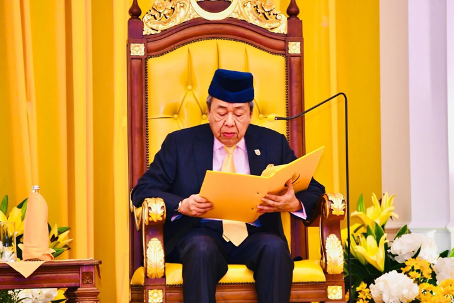
The approval for this upgrade was submitted to the Council of Rulers and was consented to by His Majesty the Yang di-Pertuan Agong through the Instrument of Grant of City Status to Klang Municipal Council dated 9 November 2023. The Klang City status came into effect on 23 November 2023. This effectively makes Klang the first Malay Royal City in the world, as well as the fourth city in Selangor and the twentieth city in Malaysia.

His Royal Highness Sultan Sharafuddin Idris Shah Alhaj ibni Almarhum Sultan Salahuddin Abdul Aziz Shah Alhaj has graciously proclaimed and decreed that, effective from 23 November 2023, the Klang Municipal Council shall be designated as a Royal City in perpetuity and shall be officially referred to as the Klang Royal City Council (MBDK) on 5 February 2024, corresponding to 24 Rajab 1445 Hijrah.